King Tribe · Seattle, WA
Take action: carry the question, take the pledge.
The question on King Tribe’s medallion is more than two hundred years old, and it has changed one word at a time. Here is where it came from, what the medallion is for, one survivor’s plea about how we speak, and the Pledge Ken King asks men to make.
Am I not a daughter and a sister?
A medallion with a lineage.
“Ladies wore them in bracelets, and others had them fitted up in an ornamental manner as pins for their hair. At length the taste for wearing them became general, and thus fashion, which usually confines itself to worthless things, was seen for once in the honorable office of promoting the cause of justice, humanity and freedom.”
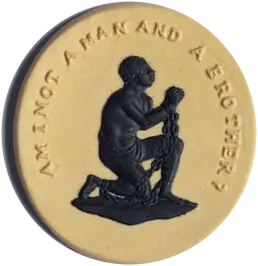
1787: Josiah Wedgwood strikes the first one
A passionate anti-slavery campaigner and friend of William Wilberforce, Wedgwood produced the first anti-slavery medallion. His design of a kneeling slave became the most easily recognizable image of the campaign against the slave trade, reproduced on pottery and medallions and widely distributed.
Am I not a man and a brother?
1788: Benjamin Franklin gets a box of them
Wedgwood sent a large number of cameos to Franklin in Philadelphia. Franklin remarked on the medallion as a way of bringing awareness of slavery to the public, and declared its effectiveness “equal to that of the best written Pamphlet, in procuring favor to those oppressed People.”
1790s: The figure moves into everyday metal
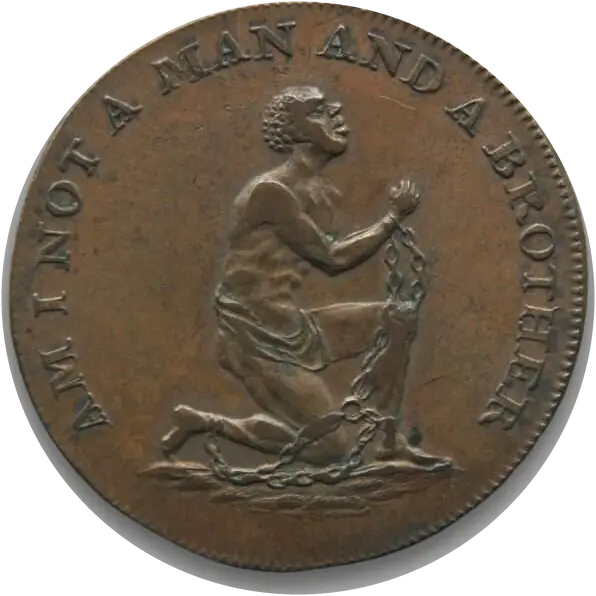
A British copper token repeats the kneeling figure and the same motto. What began in jasperware is now small enough to carry in a pocket.
Am I not a man and a brother?
1807: Parliament gives Royal Assent
It took until 1807 for a bill for the abolition of the slave trade to receive Royal Assent. Trafficking in slaves continued anyway.
1807 to 1834: Elizabeth Margaret Chandler
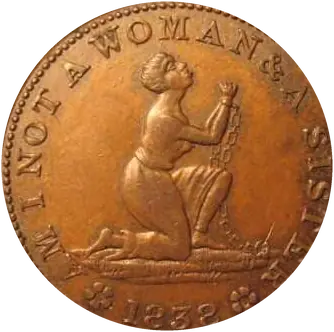
A poet and writer of Pennsylvania and Michigan, she became the first woman writer in America to make the abolition of slavery her principal theme, and she died at twenty-six. She introduced one of the most famous abolitionist images in America: the kneeling female slave, with a question of her own.
Am I not a woman and a sister?
1823: The anti-slavery society is founded
Founded through the efforts of William Wilberforce, the society kept the campaign going after the slave trade bill, toward the end of slavery itself.
1838: British slaves finally gain their freedom
The freedom Wedgwood's medallion argued for arrived. The kneeling woman and her question were being struck in copper on a token of the same year.
1865: The Thirteenth Amendment
Slave ownership became illegal in the United States. King Tribe's history of the medallion adds the hard part: it is still going on here today.
2010: Ken King strikes a new one
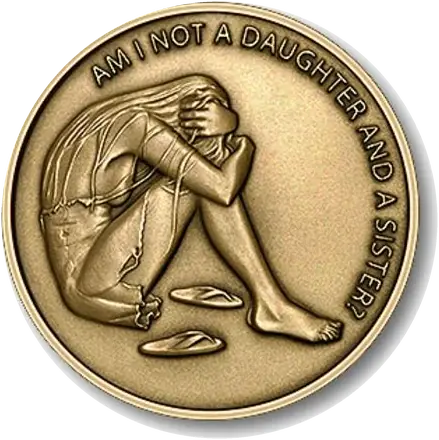
Minted by the Northwest Territorial Mint, King Tribe's medallion brings a new slogan to an old question. It focuses attention on the child sex trafficking victim. The reverse reads Proverbs 31:8-9, “Speak up for those who cannot speak for themselves.”
Am I not a daughter and a sister?
The medallion in use
Made to be handed to someone.
No price list and no shop here. If you would like to ask about medallions for yourself, your church or your organization, write to Ken King.
Start a conversation
An individual Modern-Day Abolitionist can carry the medallion and use it to open a conversation and communicate the message.
Add something tangible
Organizations can use it alongside printed material, so the message leaves with a lasting object in the hand.
Raise funds
It can also be sold to raise funds to help change the condition of the victims of human trafficking.
Shared on King Tribe’s Take Action page
A voice for the voiceless.
An essay by kathy bryan, who writes as a survivor of human trafficking. It begins with Proverbs 31:8-10 and asks us to change a phrase we have all used.
“Stop saying you are a voice for the voiceless. Rather, say you stand in solidarity with the oppressed. They have a voice.”
“Let our voices say, We stand with you! We speak against this! We demand change!”
Take the Pledge
Better men have to end the demand.
Recognizing that men create demand for prostituted children and that better men have to end the demand... And mindful of my own past failure to protect the innocence of kids by tolerating the existence of the commercial sex industry that makes them vulnerable... Today I make the commitment to becoming a better man, and my commitment is demonstrated by the following:
I will not purchase or participate in pornography, prostitution, or any form of the commercial sex industry.
Internet, TV, movies, magazines, bikini baristas, strip clubs.
I will hold my friends accountable for their actions toward women and children.
No toleration for degrading women, improper jokes, indecent pictures. Meet with, pray, lead by example, encourage.
I will take immediate action to protect those I love from this destructive market.
Become informed, partner with Anti-Human Trafficking organizations, and tell others.
I will defend our daughters with my life of integrity.
Join The Defenders USA.
To count your pledge and join, write to Ken King at ken@kingtribe.com and tell him you are taking it. The original pledge form is not something this page can reproduce, so email is the way in.
“Dear Defender, Welcome. Today you are a Defender. It’s the role men have been called to fill. It’s a pledge worth making and it’s a pledge worth keeping.”
Will you take the pledge?
One line from you is enough to start.
Keep reading: human trafficking, homelessness, hunger or about Ken King.