“Am I Not a Man and a Brother?” The Story Behind the Medallion
Some of the oldest campaigns for justice fit in the palm of your hand.
October 13, 2026 · 4 min read
In 1787, Josiah Wedgwood I, a passionate anti-slavery campaigner and a friend of William Wilberforce, produced what is remembered as the first anti-slavery medallion. It was one of the earliest tokens of public disapproval against the evils of the slave trade. The design showed a kneeling slave, and around the figure ran a motto that people found hard to forget: Am I not a man and a brother?
We think about that motto often at King Tribe. It is a question, not a slogan. It does not tell you what to think. It sits in your hand and waits for you to answer it. That is why it worked in 1787, and it is why we believe it can still work today in a city like Seattle, where most of us are busy and most of us are looking somewhere else.
How a piece of pottery became a campaign
Wedgwood’s design was reproduced on pottery and on medallions, and these were widely distributed. They became the most easily recognizable image of the campaign against the slave trade. His friendship with Thomas Clarkson, the abolitionist campaigner, had aroused his passion against slavery, and the two shared an instinct that ordinary people needed something they could see and hold, not only something they could read.
Clarkson described what happened next. He wrote that “ladies wore them in bracelets, and others had them fitted up in an ornamental manner as pins for their hair. At length the taste for wearing them became general, and thus fashion, which usually confines itself to worthless things, was seen for once in the honorable office of promoting the cause of justice, humanity and freedom.”
Franklin noticed
In 1788, Wedgwood sent a large number of cameos to Benjamin Franklin in Philadelphia. Franklin also remarked on the value of the medallion as a way of bringing awareness of the existence of slavery to the public. He declared that its effectiveness was “equal to that of the best written Pamphlet, in procuring favor to those oppressed People.”
Franklin was a printer, so he knew what a good pamphlet could do. For him to say a small medal matched the best of them tells you something. A pamphlet asks someone to sit down and read. A medallion can be worn, passed across a table, left on a shelf, and picked up by a person who had no plan to think about slavery that day. It invites a question without forcing one.
The long road
Awareness is where the work begins, not where it ends. It took until 1807 for a bill in Parliament for the abolition of the slave trade to receive Royal Assent. Even then, trafficking in slaves continued. The anti-slavery society was founded in 1823 through the efforts of William Wilberforce, and British slaves did not finally gain their freedom until 1838.
That is more than fifty years from the first medallion to the freedom of British slaves. We find that sobering and also encouraging. Sobering, because change is slow and the people who start it often do not see the finish. Encouraging, because a small, patient act of attention, repeated by many hands, was part of how it happened.
A woman and a sister
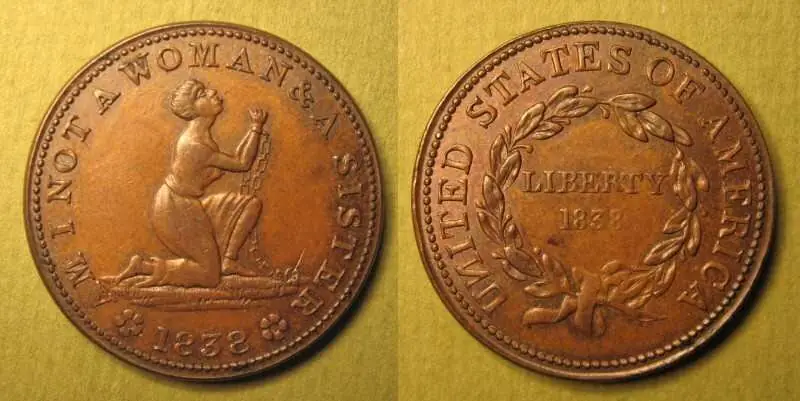
The question was asked again from the other side of the Atlantic. Elizabeth Margaret Chandler, who lived from 1807 to 1834, was a noted poet and writer of Pennsylvania and Michigan. She became the first woman writer in America to make the abolition of slavery her principal theme, and she did it before she died at the age of twenty-six. She also introduced one of the most famous abolitionist images in America, the kneeling female slave with the slogan: Am I not a woman and a sister?
Why Ken King made a new medallion
Ken King tells the story himself on the About page: “During the movement to abolish slavery in England over 200 years ago, the slave medallion was used to bring about compassion for slaves. Reading about this endeavor inspired me to create a modern-day anti-slavery medallion.” In 2010 he issued one, crafted with the Northwest Territorial Mint. It carries the words: Am I not a daughter and a sister?
Those words turn our attention to the child sex trafficking victim. The reverse of the medallion carries a line from scripture, “Speak up for those who cannot speak for themselves,” from Proverbs 31:8-9. In his own words, Ken’s hope is that it can be used “to bring awareness of human trafficking and compassion for the child sex trafficking victim.” The medallion comes in gold-, silver- and bronze-toned finishes, and as a keychain.
One question, struck four times
- 1787: Wedgwood’s medallion asks, Am I not a man and a brother?
- The 1790s: tokens carrying the same motto circulate, including the kind collectors call Conder tokens.
- 1838: a copper token asks, Am I not a woman and a sister?
- 2010: Ken King’s medallion asks, Am I not a daughter and a sister?
What you can do with a question
You do not need a medallion to take part in this history. You need a willingness to ask the question out loud and to listen when someone answers. Read the words on the coin, then ask yourself who in your own city is waiting for you to see them as a neighbor, a brother, a sister, a daughter.
If this history moved you, or if you lead a church, a family gathering or a small group in the Seattle area and would like to talk about it, write to us at ken@kingtribe.com. We would be glad to hear from you.
King Tribe, ken@kingtribe.com
Write to KenMore articles
How to Start a Conversation About Human Trafficking With Someone You Know
A hard subject is easier to raise when you have something to hold and a heart that is ready to listen.
Homeless or Individual? Seeing the Person in Front of You in Seattle
The first thing a person in need asks of us is often the simplest: to be seen.