How to Start a Conversation About Human Trafficking With Someone You Know
A hard subject is easier to raise when you have something to hold and a heart that is ready to listen.
October 13, 2026 · 4 min read
Most of us have no idea how to bring up human trafficking at the dinner table or after a church service. The subject is heavy, the words are uncomfortable, and nobody wants to be the person who ruins a pleasant afternoon. So we say nothing, and silence quietly becomes the default.
At King Tribe we have learned to treat the first conversation as a small, kind act, not a speech. You are not trying to win anyone over in five minutes. You are trying to open a door a few inches so that the next conversation is possible. Here is how we think about it.
Start with something you can hold
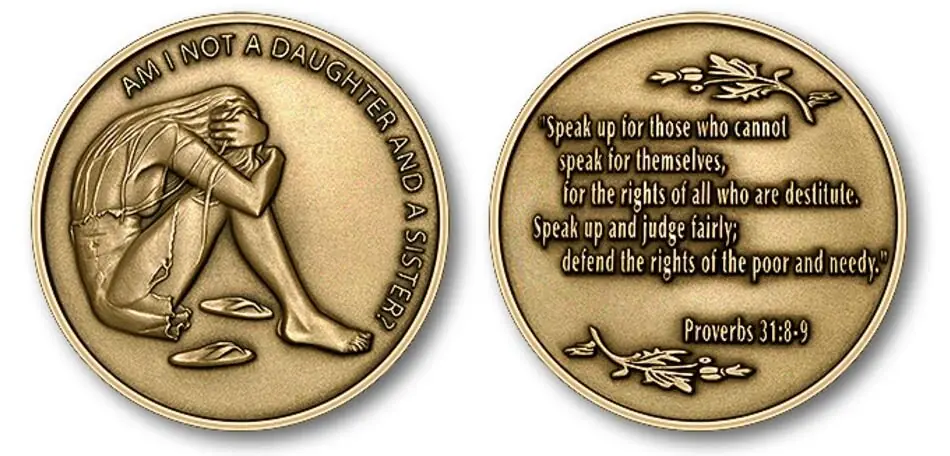
An object does a lot of the talking for you. The anti-slavery medallion Ken King issued in 2010 was made for exactly this. On the front is a question: Am I not a daughter and a sister? On the back is a line from scripture. When you set it on a table, nobody has to be lectured. They pick it up, turn it over, and ask what it is.
The old abolitionists understood this. Their medallions were worn and passed around, and the question on them did the first part of the work. You do not need our medallion in particular. A verse, a photograph of a historical token, a book from your shelf, or the printed words of the question can serve the same purpose. The point is to give the other person something to react to besides you.
Ask before you tell
A good first sentence is a question, not a claim. Some that have worked for people we know:
- “I came across something about modern slavery and it has stayed with me. Have you ever thought about it?”
- “Do you know where the phrase ‘Am I not a man and a brother?’ comes from?”
- “I have been reading Proverbs 31 and it says something I did not expect. Can I read it to you?”
Then stop talking. Let the silence do its work. People often surprise you. One person will say they have never given it a thought. Another will tell you about a documentary, a news story, or something they saw that bothered them and that they never mentioned to anyone. You cannot know which until you ask.
Listen more than you speak
Listening is the whole skill. Resist the urge to correct, to quote a figure, or to supply the answer. If someone says they do not believe this happens near them, you do not have to argue. You can say, “I understand why it seems far away. I felt the same way.” Honesty about your own start makes it safe for them to be honest about theirs.
Keep the conversation non-graphic. You do not need to describe what victims endure, and in a mixed group, with children or with anyone who may carry their own painful history, it can do harm. You can speak seriously about the wrong of exploiting a child without painting the details. The seriousness comes through the care in your voice.
Let scripture carry some of the weight
The reverse of our medallion reads “Speak up for those who cannot speak for themselves,” from Proverbs 31:8-9. For many people of faith that is the doorway. It reminds us that speaking is not optional decoration on a Christian life. It is part of loving a neighbor.
One caution, offered with respect. kathy bryan, a survivor of human trafficking, wrote an essay that is posted on our Take Action page. She asks us to think about how we speak. She suggests we stop saying we are a voice for the voiceless, and say instead that we stand in solidarity with the oppressed, because they have a voice. “Let us empower their voices,” she writes, “and as those fighting for justice and assisting them, let us welcome their voices.” Her words are worth carrying into every conversation you have on this subject. It changes how you talk about people who have been hurt.
Know what a good first conversation looks like
- Say what moved you, in your own words, and say it briefly.
- Invite their view and honor it, even when it is skeptical.
- Offer one small next step, such as reading a page together or praying for those who are suffering.
- Thank them for listening, and mean it.
When the subject gets close to home
Sometimes a conversation turns personal, and the person across from you tells you something about their own life. Slow down. Do not rush to fix. Say that you are glad they trusted you and that you are sorry. If you believe someone is in immediate danger, contact local emergency services right away. If someone needs ongoing help, encourage them toward trained professionals and trusted people in their community. You are a friend in that moment, not a rescuer, and being a steady friend is a great deal.
Then keep going
One conversation will not end human trafficking. Neither did one medallion end the slave trade. But the early abolitionists made a habit of asking the question where people could hear it, and over time the question changed what a whole society was willing to tolerate. Ken King’s hope is that his medallion can be used to bring awareness of human trafficking and compassion for the child sex trafficking victim. Your living room, your small group or your Sunday lunch is a fine place to put that hope to work.
If you try this and want to tell us how it went, or if you would like to talk through a conversation before you have it, write to ken@kingtribe.com.
King Tribe, ken@kingtribe.com
Write to KenMore articles
“Am I Not a Man and a Brother?” The Story Behind the Medallion
Some of the oldest campaigns for justice fit in the palm of your hand.
Homeless or Individual? Seeing the Person in Front of You in Seattle
The first thing a person in need asks of us is often the simplest: to be seen.